

Belgian-American physicist Francis Halzen has won the 2026 Nobel Prize in Physics for decisive contributions to the IceCube Neutrino Observatory and the discovery of high-energy neutrinos of astrophysical origin, the Royal Swedish Academy of Sciences announced October 6, with congratulations reported by the Niels Bohr Institute at the University of Copenhagen and other IceCube institutions.
Halzen, 82, a professor at the University of Wisconsin-Madison, receives the prize alone, along with 12 million Swedish kronor, about 1.2 million United States dollars. He has often stressed that IceCube is the work of a large international collaboration, which today involves hundreds of scientists at dozens of institutions, and colleagues shared in the celebrations.
The idea dates to 1988, when Halzen and a colleague proposed using the deep, clear ice of Antarctica as a detector. Neutrinos are nearly massless particles that pass through almost everything and are rarely stopped by matter or bent by magnetic fields, which makes them exceptionally hard to catch but also exceptionally valuable. Coming straight from violent cosmic environments, they can carry information that light cannot.
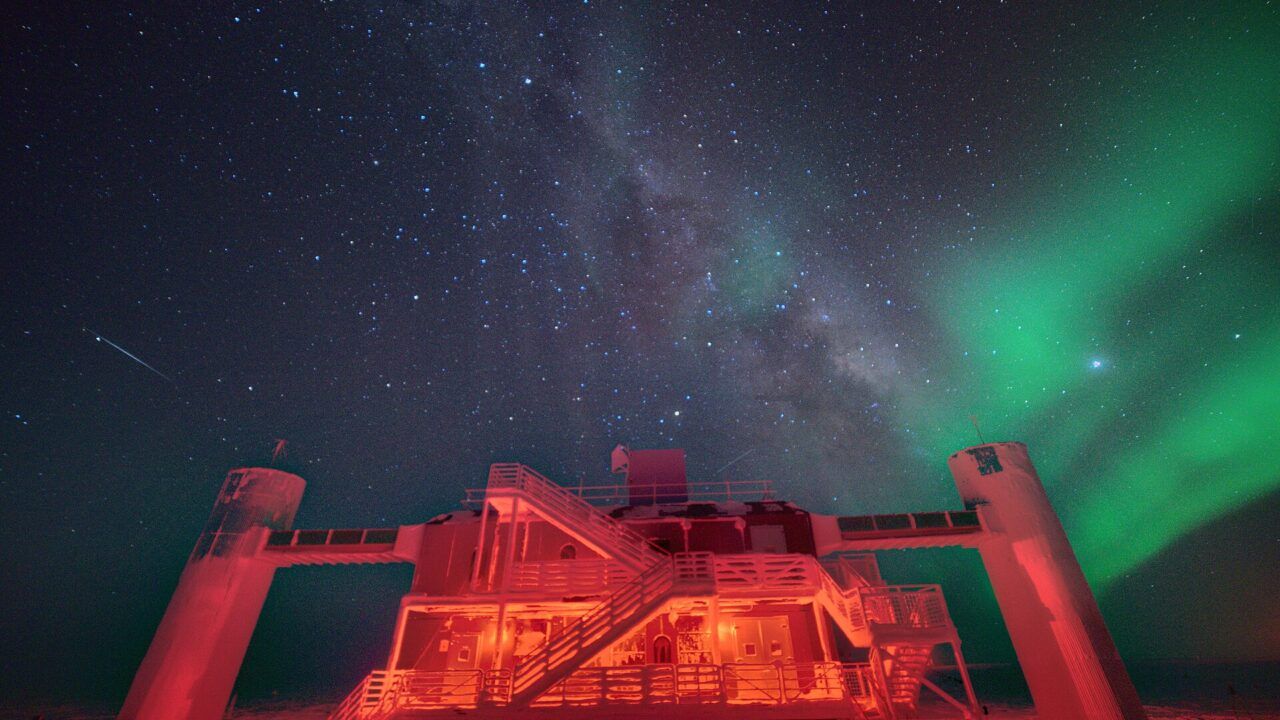
IceCube turns that idea into hardware at the Amundsen-Scott South Pole Station. More than 5,000 basketball-sized light sensors are frozen into about a cubic kilometer of ice, between roughly 1.5 and 2.5 kilometers below the surface, lowered on cables into holes melted with hot water. When a high-energy neutrino does collide with a nucleus in the ice, the interaction creates charged particles that emit faint Cherenkov light. The pattern, brightness and timing of those flashes let scientists estimate the neutrinos energy and the direction it came from.
The observatory was completed in 2011, building on the earlier AMANDA prototype. In 2013, IceCube reported evidence of high-energy neutrinos arriving from beyond the Solar System, the result that established neutrino astronomy as a working field. Later work associated a neutrino with the blazar TXS 0506+056 and built the case for candidate sources such as the active galaxy NGC 1068, though definitive source identifications remain provisional and researchers are pursuing larger detectors, including an IceCube expansion, to sharpen the pointing.
The Nobel committee credited Halzens tenacity and vision in leading the international team that built the instrument. The prize recognizes a second way of seeing the universe alongside light, one that has taken decades of drilling, computing and collaboration at the bottom of the world to bring into focus.
The observatorys scale was dictated by the neutrinos elusiveness. Trillions pass through every person each second without effect, so catching a handful of the highest-energy examples required instrumenting a cubic kilometer of the clearest natural ice on Earth and waiting. The payoff is a telescope that never sleeps and cannot be pointed wrong: the Earth itself filters out most backgrounds, letting IceCube watch the whole sky through the planet for neutrinos energetic enough to stand out.
That capability has made IceCube a hub for multimessenger astronomy, in which the same cosmic event is studied through light, gravitational waves and particles together. When IceCube issues an alert for a promising high-energy neutrino, telescopes around and above Earth swing to the indicated patch of sky within minutes. The Nobel recognition, colleagues at the Niels Bohr Institute and elsewhere noted, honors not only Halzens original proposal and leadership through the AMANDA prototype era, but also the model of long-term, internationally shared infrastructure that made a new field possible.