

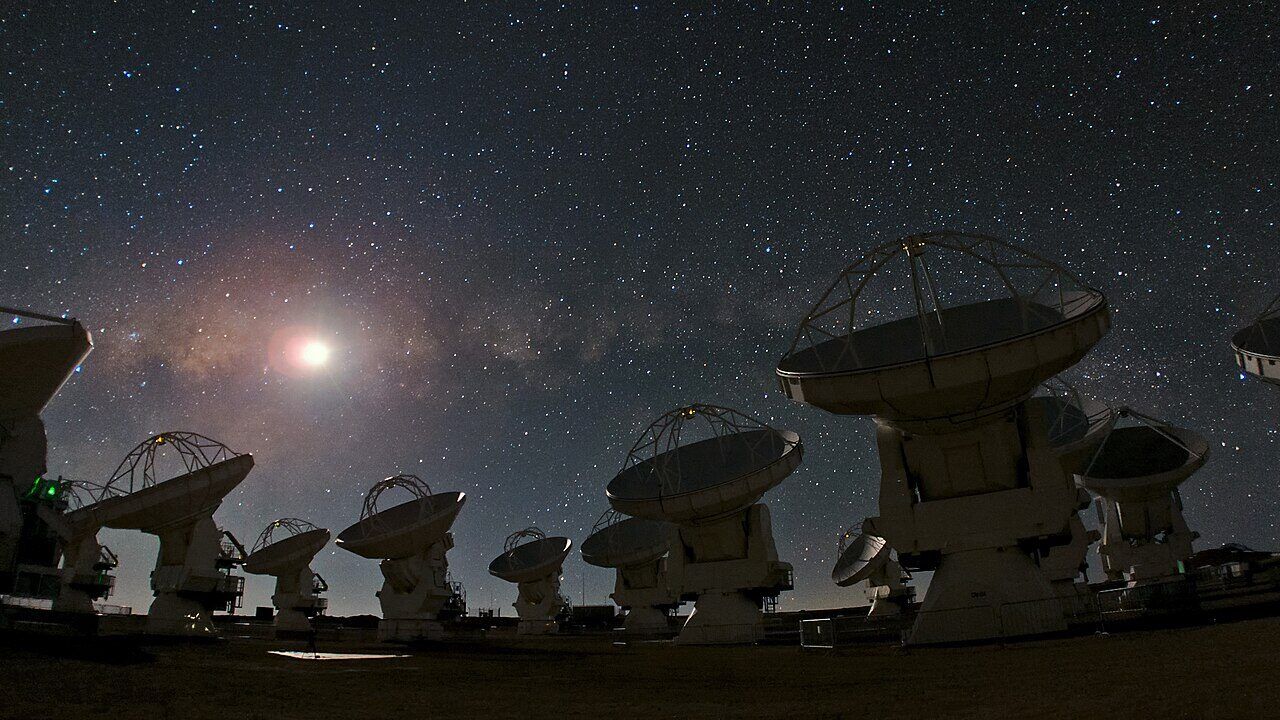
Astronomers using the Atacama Large Millimeter/submillimeter Array have detected fully deuterated methanol in space for the first time, around a young star still forming about 1,000 light-years from Earth, according to the ALMA Observatory, the United States National Radio Astronomy Observatory and Phys.org.
The result comes from the ALMA COMPASS Large Program, short for Complex Organic Molecules in Protostars with ALMA Spectral Surveys. The international team spent more than 100 hours of telescope time systematically studying 11 nearby young, Sun-like stars, looking at the chemistry that surrounds them before planets have finished forming. The findings were released October 7 across a set of seven papers.
Methanol, the simplest organic alcohol, is a key stepping stone in interstellar chemistry. On icy dust grains it can react with atoms such as carbon, oxygen and hydrogen to build larger, more complex molecules. In the COMPASS data, methanol appears in several forms, from the common version with ordinary hydrogen to rarer forms in which heavy hydrogen, deuterium, replaces hydrogen atoms one by one. The fully deuterated form, written CD3OD, had never been confirmed in space. The team found its unambiguous signature around the protostar IRAS 4A2 in the Perseus molecular cloud. It is also the first quadruply deuterated molecule detected in the interstellar medium, the researchers said.
Deuterated molecules are prized as record keepers because they form preferentially under extremely cold conditions, typical of the earliest stages of star formation, before a star ignites. Finding the heaviest version of methanol therefore preserves a chemical memory of the cold cloud that existed tens of thousands of years before the star switched on. The survey also found methanol masers, naturally amplified emissions, in more than half of the young stars studied, suggesting such emission may be a common feature of early stellar evolution when observations are sensitive enough.
Principal investigator Jes Jorgensen of the Niels Bohr Institute at the University of Copenhagen said the program is providing completely new insights into the complex chemistry around the youngest protostars, and raised the question of how those ingredients may influence conditions on planets and potentially the origin of life there.
The team is careful not to claim that finding an alcohol in space means life is present. The significance is more basic: the chemical starter kit delivered to planet-forming disks appears richer, and starts earlier, than many models assumed. Analysis of the full COMPASS dataset continues, extending the inventory to all detected species across all 11 sources to learn whether differences between systems are inherited from their birth clouds or develop as stars evolve.
ALMA achieves this chemistry by listening for molecular fingerprints. Each molecule radiates at characteristic frequencies as it rotates, and by tuning its antennas to those frequencies, astronomers can identify species and map where they sit relative to a young star, on scales comparable to our own Solar System. Protostars are ideal and difficult targets at once: rich in molecules, but still buried in the cold envelopes that feed them, which is why a systematic survey rather than a single-object study was needed.
The fully deuterated methanol detection also gives laboratory chemists and modelers a hard target. Deuterium enrichment happens through reactions that only proceed efficiently at temperatures near ten degrees above absolute zero, so the abundance of CD3OD relative to ordinary methanol is a thermometer and a clock for the prestellar phase. If models cannot reproduce the measured ratios, the chemistry in the models is wrong in a specific, fixable way. That feedback between telescope, laboratory and theory is how astrochemists expect the COMPASS catalog, hundreds of spectral lines across eleven systems, to be used for years.