

Astronomers have traced the most distant fast radio burst ever recorded to a small, young star-forming galaxy that existed when the universe was about 3 billion years old, NASA, the University of Oxford and the South African Radio Astronomy Observatory reported with the publication of the research in Science on October 8.
The burst, designated FRB 20240304B, was detected on March 4, 2024, by the MeerTRAP project using South Africas MeerKAT radio telescope. Its radio signature suggested an extreme distance, but measuring that distance required finding its host galaxy, which was too faint for the largest ground-based telescopes. NASAs James Webb Space Telescope observed the location with its NIRCam instrument and identified the galaxy, confirming a cosmological redshift of 2.148.
Fast radio bursts are millisecond flashes of radio waves that can release, in that instant, energy comparable to what the Sun emits over far longer periods. First recognized in 2007, they remain one of astronomys open puzzles, and most are seen only once. This burst traveled for more than 10 billion years before reaching Earth, more than doubling the previous distance record for a localized burst, according to the research team led by Manisha Caleb and Themiya Nanayakkara at the University of Sydney.
The host galaxy is part of the surprise. It is far smaller and younger than researchers expected, an actively star-forming dwarf with few heavy elements. That environment favors an origin involving a magnetar, a young and highly magnetized neutron star left behind by an exploded massive star, over scenarios that need long delays, such as mergers of older stellar remnants. The team stresses that one burst cannot settle the question for all fast radio bursts, but any general explanation now has to account for bursts arising in young, metal-poor galaxies.
The flash also worked as a probe of everything it passed. As the radio signal crossed billions of light-years, matter along the path left imprints on it, including signatures the team attributes to a previously unknown galaxy cluster at a redshift of 0.3 and to the nearby Virgo Cluster. Researchers describe such bursts as cosmic flashlights that can reveal otherwise invisible material between galaxies.
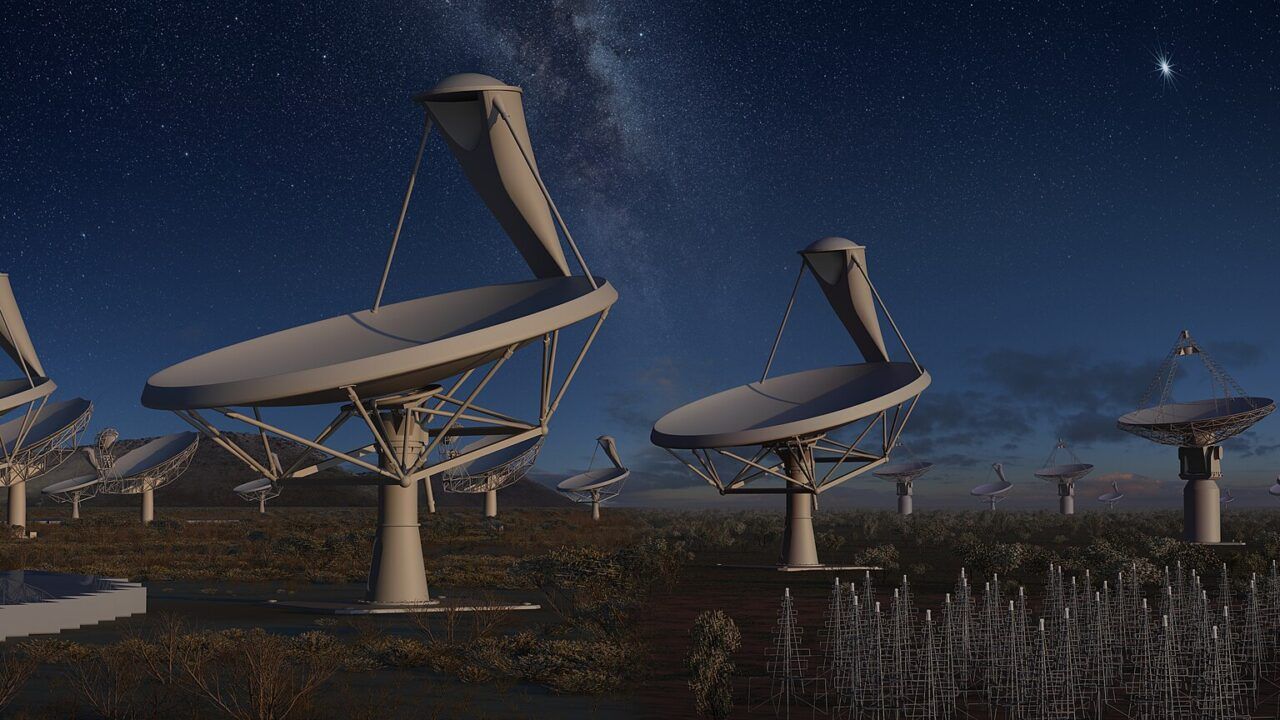
By pairing sensitive radio arrays such as MeerKAT, and in future the Square Kilometre Array, with Webbs ability to characterize faint hosts, astronomers expect to push this kind of measurement deeper into cosmic history and learn both how bursts are made and how matter is distributed across the universe.
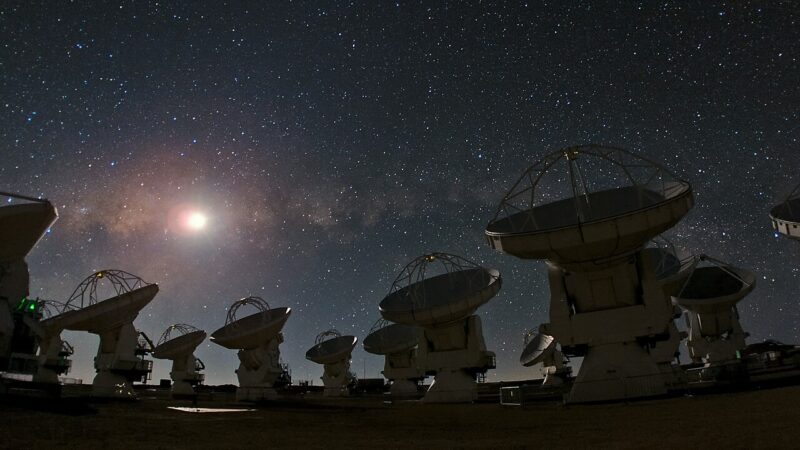
The localization is a technical milestone in its own right. A burst lasting a millisecond must first be caught by a wide-field radio array, then pinpointed precisely enough that an infrared space telescope can search a tiny patch of sky for a galaxy almost too faint to see. MeerKAT, in South Africas Northern Cape, provided the detection and position through the MeerTRAP project, while Webb supplied the sensitivity to detect the host and measure its redshift from the stretching of its light by the expansion of the universe.
A redshift of 2.148 places the burst in an era when star formation in the universe was near its historical peak. That timing is part of the scientific payoff. If the youngest, most distant bursts preferentially live in small star-forming galaxies, the population can be used to trace where matter and metals were at that epoch, not just where bright galaxies shine today. With the Square Kilometre Array under construction, astronomers expect samples large enough to turn individual records like FRB 20240304B into statistical maps of the cosmic web.