

NASA has commissioned an all-glass test telescope from L3Harris Technologies as part of its contribution to LISA, the space mission that will detect gravitational waves.
The engineering test unit is made from Zerodur, a ceramic glass prized for its stability, and will help prove the design of the telescopes that will fly on the three LISA spacecraft.
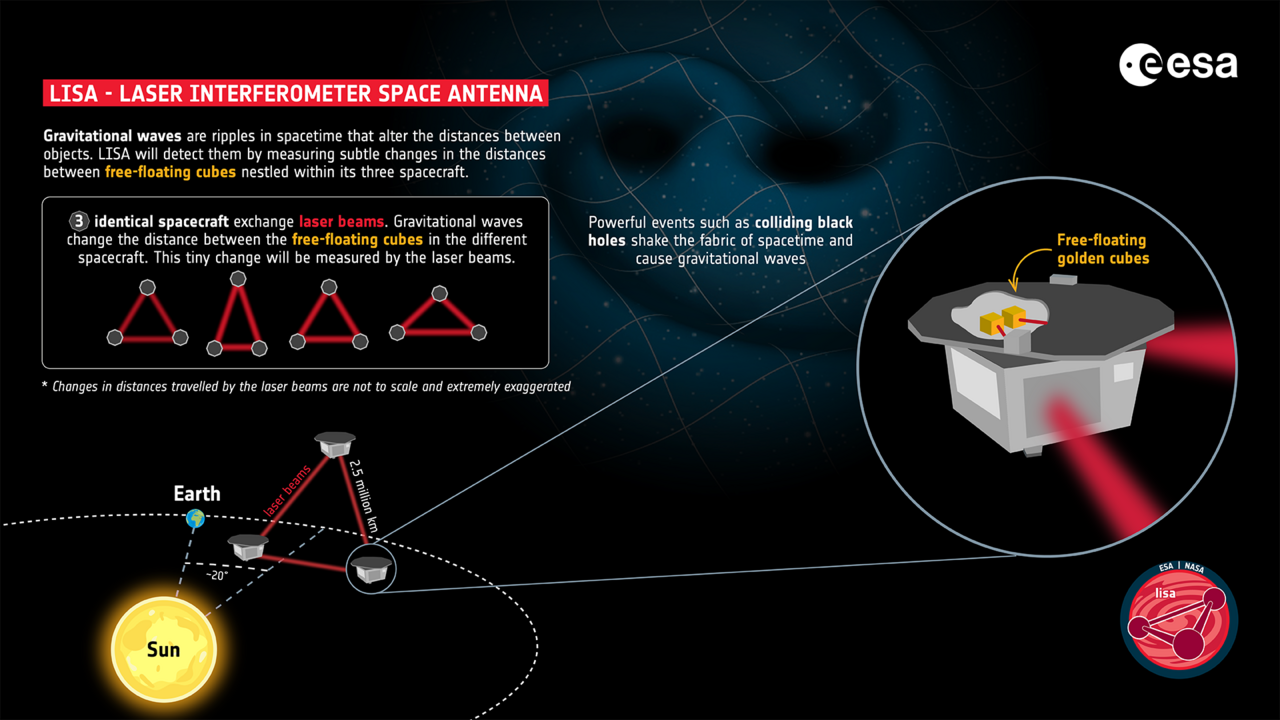
LISA — the Laser Interferometer Space Antenna — will place three spacecraft in a triangular formation 2.5 million kilometers apart, using lasers to measure ripples in spacetime caused by merging black holes and other cosmic events.
The mission, led by the European Space Agency with NASA participation, is targeting a launch in the mid-2030s and would open a new window on the universe, complementing ground-based gravitational-wave observatories.
According to the organizations involved, the test telescope is a key step toward turning the ambitious design into flight hardware.
Zerodur’s near-zero thermal expansion makes it ideal for the exquisitely precise measurements LISA requires. Even tiny distortions from temperature swings could swamp the faint gravitational-wave signals the mission seeks.
With launch targeted for the mid-2030s, the engineering test unit gives NASA and its partners years to validate the design before flight hardware is built — a deliberate, careful pace for a mission more than a decade in the making.
If it succeeds, LISA will hear what no telescope can see: the mergers of supermassive black holes, ringing across the cosmos in ripples of spacetime itself.
L3Harris, which has built optics for flagship NASA observatories, says the all-glass approach reduces the risk of distortion that can plague metal mirrors in the extreme thermal swings of deep space.
The test unit will now undergo rigorous evaluation, including vibration and thermal-vacuum testing, to prove it can survive both the violence of launch and the quiet cold of its eventual orbit.
For now, the telescope remains on Earth — but its destination is nothing less than the fabric of the universe.