

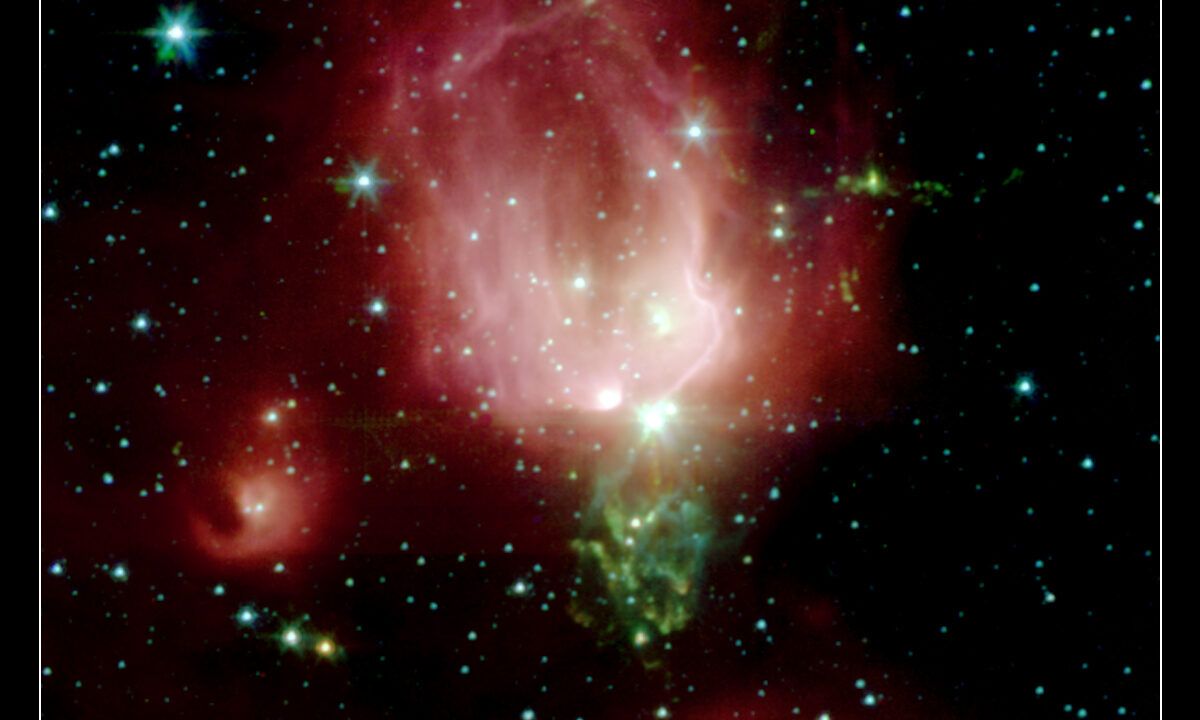
Some places in the galaxy are factories. NGC 7129 is one of them: a star-forming region where a young cluster is blowing bubbles in its own birth cloud, carving cavities with winds and radiation while new stars ignite inside the wreckage. In this zoom video from HubbleWebbESA, the joint Hubble and Webb channel, the view pushes steadily into that commotion, moving from a wide field toward the glowing heart of the nebula where jets from newborn stars punch into cold gas.
It is worth watching slowly. Infrared eyes such as Webbs do not see this region the way a backyard telescope would. Dust that looks opaque in visible light becomes translucent, and stars still wrapped in their natal material appear where an optical image shows only darkness. Astronomers studying regions like this are tracing a chain of cause and effect: a molecular cloud collapses, massive stars switch on, their outflows compress some gas into the next generation while dispersing the rest. The blue-tinted disk structures and swept cavities captured in recent Webb reporting on this field are the physical evidence of that negotiation between creation and dispersal.
Videos like this one are more than pretty flights. A zoom preserves context. It shows scale, where the bright core sits inside the larger cloud, and it reminds us that every pinpoint is a sun in the making, surrounded by material that may one day assemble into planets. Watch the edges as much as the center: that is where the cloud is being eroded, and where the story of the next stars is being written.
Credit: HubbleWebbESA