

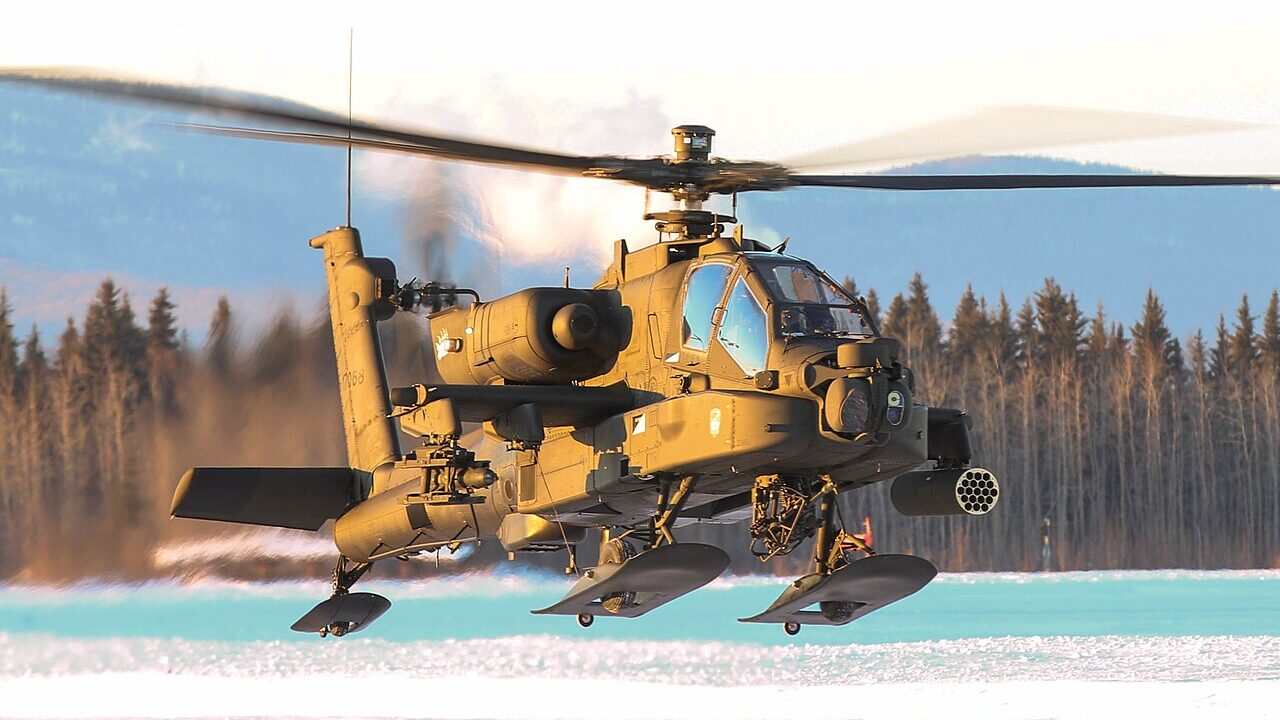
The United States Army has grounded roughly 400 of its AH-64E Apache attack helicopters — more than half the fleet — ordering an immediate pause in flight operations while engineers inspect a transmission system linked to a string of serious mishaps.
The order, announced on 2 October, applies to Apaches fitted with Improved Drive System transmissions and is expected to remain in force for months, an Army official told reporters. About 400 of the service’s roughly 700 Apaches are affected, reaching every active-duty and National Guard attack aviation unit. The Army said the action followed ongoing technical and airworthiness assessments, including earlier safety directives, inspection results and maintenance reports.
A troubled transmission
The Improved Drive System has been under scrutiny for months. An internal Army safety assessment reported earlier this year found the transmissions could suffer an internal failure causing loss of accessory gearbox drive, which can in turn knock out tail-rotor thrust, electrical power and hydraulics. Since last October, at least four AH-64Es have been involved in the most severe category of flight mishaps, including one described as a catastrophic transmission failure — compared with three such mishaps across all other Army helicopter types combined.
The grounding is the second safety stand-down for the Apache in two months. In August, the Army briefly grounded the entire fleet after an AH-64 crashed in a field near Fort Hood, Texas, killing both pilots. Officials were quick to note that the Fort Hood aircraft was an older variant and that transmission issues were rapidly ruled out as a cause of that crash.
What it means for readiness
Attack helicopters are among the Army’s most flexible weapons, providing close air support, reconnaissance and escort for ground forces. Taking more than half the fleet offline for months will strain training schedules and deployment rotations, even as Washington juggles overlapping security commitments abroad, from continued support for Kyiv to deterrence in the Pacific.
For now, the Army says safety comes first and that further details will follow when appropriate. How quickly engineers can clear the suspect transmissions — and whether the fix requires a redesign, a replacement programme or targeted repairs — will decide how long the Army’s workhorse attack helicopter stays on the ground.